Category: For Historical Fiction Fans
An October Reminder–Not all Historical Facts are Fixed In Stone
One thing it is vital to keep in mind whether you are writing historical fiction, reading it, or studying history—what we “know” for certain in history often changes. New studies, new information, new scholarship and interpretation can challenge and change accepted facts, and undercut theories that have stood for decades or even longer.
I have an example from A Day of Fire: A Novel of Pompeii.” For many years the eruption of Vesuvius was set down as having happened in August of 79 A.D. The prolific and influential historian Mary Beard subscribed to this date as did pretty much every historian specializing in ancient Rome. Then new analysis was done and new physical evidence unearthed—including:
Autumnal fruits including pomegranates, (which ripen in late September and October in Italy)as well as dried dates, prunes, and figs, typically harvested in late summer during new excavations;
Jars with fermenting wine, indicating that the grapes had been harvested and wine production was well underway at the time Vesuvius blew.
AND—the most compelling evidence—a Roman coin minted after September 7 or 8 of the year 79 CE found in a stratification that ruled out the possibility that it was dropped at the site later by looters or investigators
SO, based on that evidence —presto change—the date of the destruction of Pompeii was moved from August to late September. THEN MOVED AGAIN, when FURTHER EXCAVATIONS AT THE CITE UNEARTHED GRAFFITI DATED IN OCTOBER OF 79 CE
LAST TIME I CHECKED the date of Pompeii’s destruction is considered to be in late OCTOBER. But you know that could shift further as more artifacts are uncovered.
THAT’S JUST ONE fascinating reminder that we ought not be too sanguine about what we know to be “the truth.”
[This post was taken from part of a biannual University lecture that I give]
Laurie Reads About Ancient Pompeii (#CatsWhoRead Continues)
Laurie is well known as an adventurer but this version of “the floor is Lava” may be one step too far 😉
Laurie LOVED our six-author novel—A Day of Fire: A Novel of Pompeii—though he was disappointed that no cats were featured. I explained to him that very few cat remains were found in the excavation of Pompeii. He replied that just means cats were smart enough to get out. So we did a little searching and here is the link to an interesting blob post speculating on “Why no cat remains were found during the excavations in Pompeii.” Below you will find a description of A Day of Fire.
🔥🔥A DAY OF FIRE 🔥🔥
Pompeii was a lively resort flourishing in the shadow of Mount Vesuvius at the height of the Roman Empire. When Vesuvius erupted in an explosion of flame and ash, the entire town would be destroyed. Some of its citizens died in the chaos, some escaped the mountain’s wrath . . . Six authors bring to life overlapping stories of patricians and slaves, warriors and politicians, villains and heroes who cross each other’s path during Pompeii’s fiery end. But who will escape, and who will be buried for eternity?
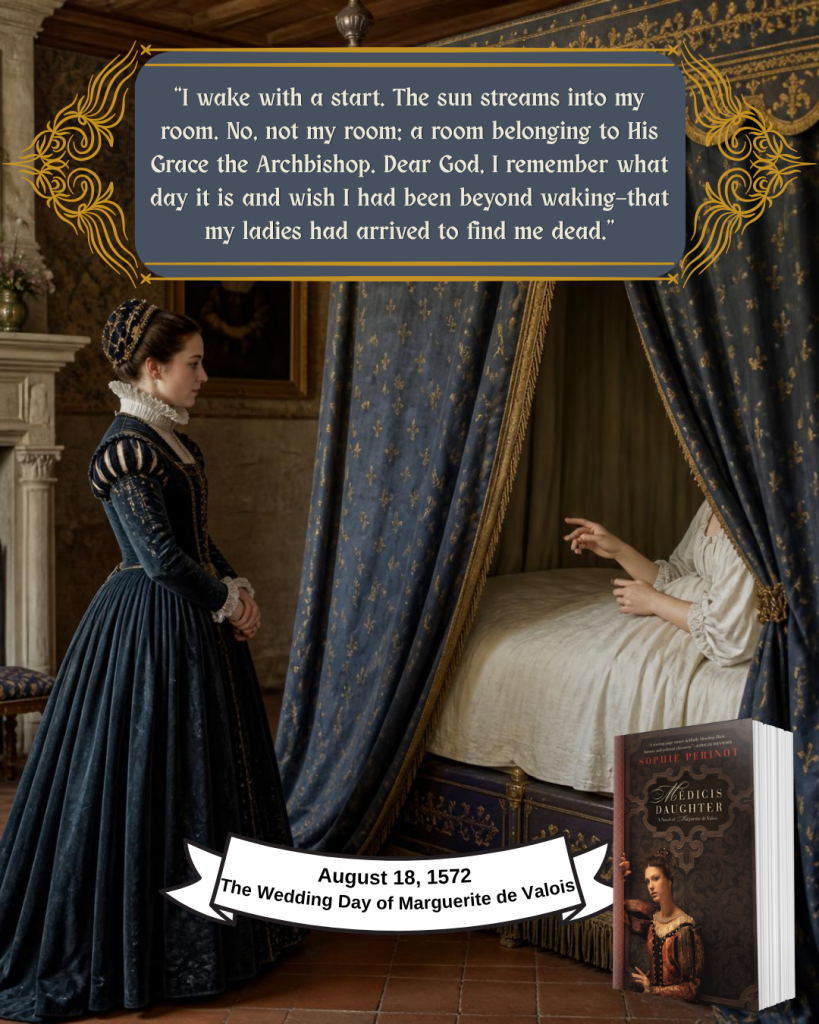
On This Day in Herstory–the Wedding of Marguerite de Valois and Henri of Navarre
ON THIS DAY IN HERSTORY—A dreaded wedding that will lead to bloodshed.
When Marguerite de Valois first arrived at Court to be with her mother—the powerful Queen Catherine de Médicis—she was eager to be an obedient daughter, and thus embraced her duty to make a political marriage.
Then Margot found herself charmed by the powerful and charismatic Duc de Guise and fell in love with him. This fact didn’t matter one whit when it came to the Princess’s destiny.
While her heart belonged to the Duc de Guise, Margot’s hand in marriage was brokered to Henri of Navarre, her cousin and a powerful Huguenot leader. The match was publicly presented part of a truce and to calm the violence and bring an end to the Wars of Religion in France between the Crown/Catholics and the Protestants. Many accept that at face value and the city of Paris filled with Protestant guests for the big day.
The wedding —which Margot had come to dread—Took place on August 18, 1572. It would be followed only days later by the bloodshed of the St. Bartholomew’s Day Massacre. The impact of that horrific event had a profound effect on Margot’s relationship with her mother.
A Quick Reminder of the “Other Me”
Just want to put Evie-me back on my readers’ radar. If you enjoyed my historical novels, I PROMISE you will LOVE Lady Margaret Dove, the amateur detective at the center of the 1666 plot in Evie-me’s dual-timeline AND BY FIRE.
Margaret and her side-kick, a royal fireworks maker, undertake a search for close friend after he goes missing during the Great Fire of London (click here for some fearsome facts about The Great Fire). While looking for this bookseller, they discover foul play in the supposedly accidental destruction of St. Paul’s Cathedral during the massive conflagration that was the Great Fire … and they being to suspect that same devilry led to murder.
Ultimately, their conclusions and “case notes” fall into the hands of the novel’s modern-day detective—DI Nigella Parker with the City Police of London—and her side-kick, a DI from Scotland Yard (to learn or about London’s two separate police forces click here). The modern-day pair are investigating a murderous arsonist who is willing to burn people for his art. Can Margaret’s centuries-old detecting help Nigella catch a modern-day murderer?

Illustrated Quotes
Dear Readers, as you may have noticed I tend to do illustrated quotes in spurts. Last month I went long on The Sister Queens. This month I seem to be wandering from the 13th to the 16th century and to the Valois Court of France featured in Medicis Daughter.
Because I am a writer who looks to reintroduce or rehabilitate figures forgotten or misrepresented in history Margot meant a great deal to me as a character as I crafted that novel. The least favorite child of her mother, never considered unless it was as a political pawn, and then defamed by history when her husband needed a divorce, Margot was in fact a brilliant woman with a political savvy that approached that of her mother, Queen Catherine de Medicis.
For those of who’ve read Medicis Daughter, what did Margot’s situation make you feel? Were you proud of her in the end? I certainly was.

The Thread that Defines My Novels
Recently, I realized that while I’ve produced multiple book-trailers, I’ve never made an author-trailer. So, I created the video below to unite my work in a single place . . . and in doing so emphasize the continuity. Because there is a common thread that runs through it, and through me. I hope you enjoy the short film.
The Second Coronation of Henry the Third of England
On this day in history . . .
On May 17, 1220 Henry III of England was crowned for the SECOND TIME with a coronation at West Minster Abbey. His first coronation—in 1216 at Gloucester Cathedral—was a hasty one and took place amidst civil war and the loss of the original crown. His second at Westminster Abbey ceremony served to formally cement Henry’s succession under peaceful conditions.
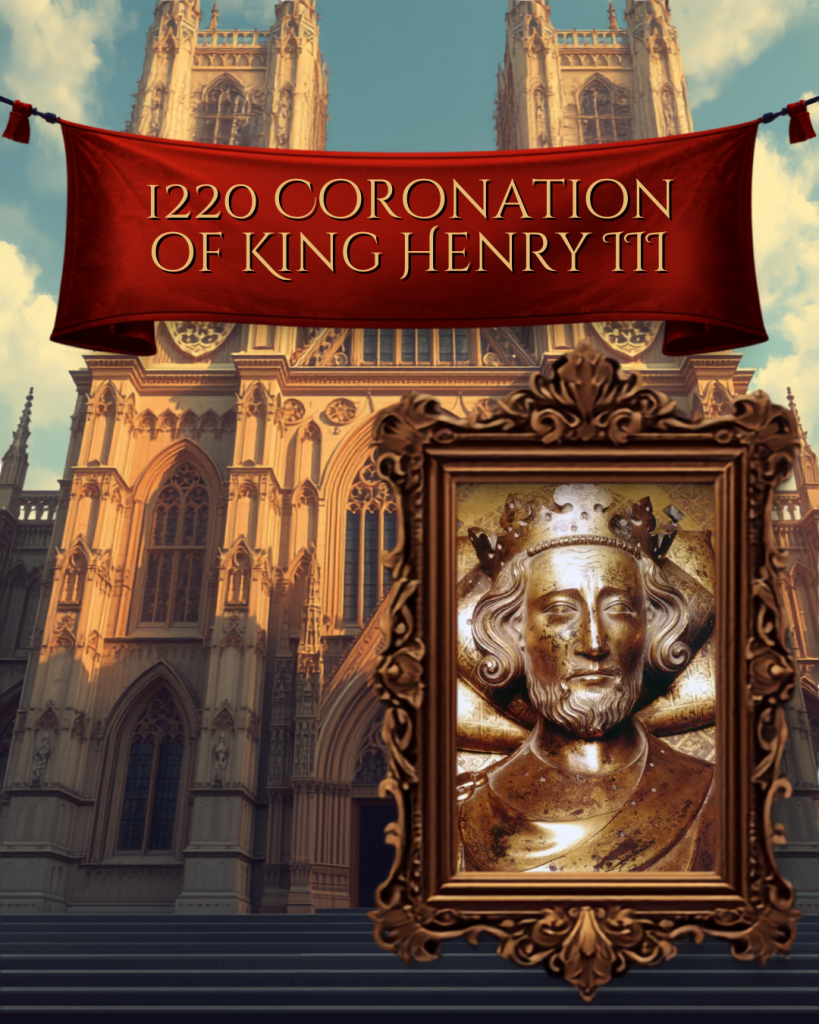
Often associated solely with the Baron’s Rebellion, there was much more to Henry and to his reign. I think of him as the visionary who rebuilt Westminster Abbey. Most of what stands today was his creation with only two significant renovations/additions after his death and outside his plan. To say Henry spared no expense on the Abbey renovation might be an understatement he spent more than £45,000 at the time which would be more than £15 million in the present day.
I also think of Henry as a marvelous husband to his wife Eleanor of Provence—daughter of Raymond Berenger V, Count of Provence whom he married on the 14th of January 1236 and one of two heroines in my novel The Sister Queens. He was also a devoted husband to their children. I am talking about the kind of dad who’d get top marks today even though he lived in the 13th century. He grieved so deeply over the death of his youngest daughter, Katherine, at age three that the Royal Court feared for his life. And he paid to have a mass said for her everyday by the same priest until that priest too was dead.
For more about Henry and his visionary role in the renovation of Westminster Abbey, start with a visit the Westminster site here.
UK Readers, Meet Me at the Roman Festival in York
On the 23d and 24th, a collection of authors–myself included–will be occupying (not in an armed sense) tents in the Museum Garden. I am talking historical writers like my good friend Simon James Atkinson Turney, Simon Elliott (also an archaeologist) and Alex Gough. . .you get the idea. So historical fiction lovers in Yorkshire please stop by to chat, and pick up a book or two.

Happy 507th Birthday to Catherine de Médicis
Catherine de Médicis—a key character in my novel, Médicis Daughter and chief antagonist of it’s main character, Princess Marguerite—is remembered for her fierce political influence over each of her three sons who reigned in turn as King of France. But, as we celebrated her 507th birthday, it’s important to remember Catherine did not begin her life with power or, for that matter, with much to celebrate.
Although Catherine had illustrious parents—her mother was a French princess of royal blood and her father was Lorenzo de’ Medici—both were dead within a MONTH of her birth (and that was, incidentally, only about a year after their marriage). After they were gone, and because of her mother’s connection to the French crown, King Francis I claimed the right to raise the orphaned Catherine. But Pope Leo told the French King to pound salt. His Holiness didn’t real care about the infant Catherine—he just viewed her, Lorenzo’s legitimate heiress, as a useful pawn. Later in life, Catherine would remark that her eventual father-in-law, Francis I, was more of a father to her than His Holiness had ever been.
In the fall of 1533 when Catherine (they aged 14) was at last shipped off to France—to marry the future Henri II—her new husband was not even Dauphin. He was merely a second son. And he was already in love with his established Mistress Diane de Poitier. Diane was more sophisticated and far better looking than Henri’s new bride, and he showed very little interest in his wife. Catherine’s new country wasn’t impressed with her either. A report from one of the Venetian ambassadors declared that “all of France” disapproved of the marriage. So, Catherine’s experiences of being marginalized and rejected, begun in childhood, continued.
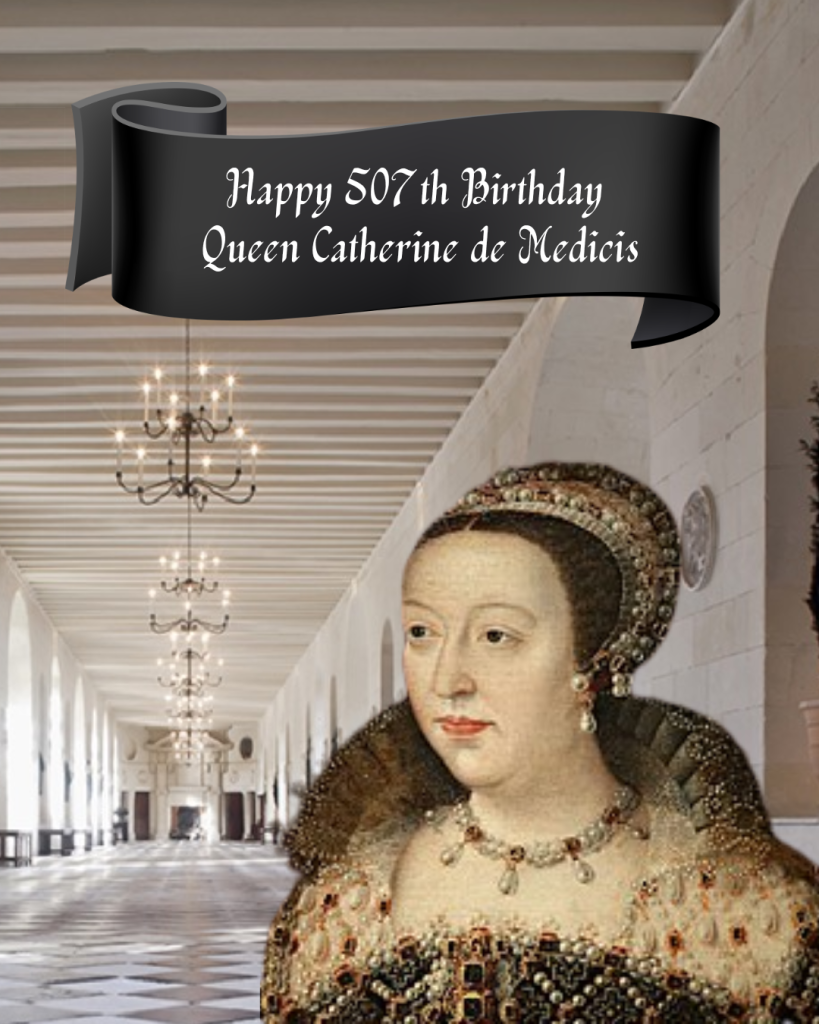
Yet from these inauspicious beginnings Catherine rose to be one of the 16th century’s true female power-players. A Queen who, left widowed with a large family, managed to keep her husband’s line securely on the throne during a time of nearly continual war. A woman who “managed” a series of boy kings—although arguably to their detriment and France’s.
Historians may disagree strongly on both the content and efficacy of Catherine’s policies with respect to the Wars of Religion—and just about everything else—but no one would disagree that she was a key influence in the post-Henri II Valois era. As such she deserves as much credit for what went right in that period as she does blame for what went wrong.
The Anniversary of the Death of King Charles IX
Today’s post features a Valois historical event closely linked to my novel Medicis Daughter. Four-hundred-and-fifty-two years ago today, Marguerite de Valois’ second oldest brother, King Charles IX of France passed away in his twenties.
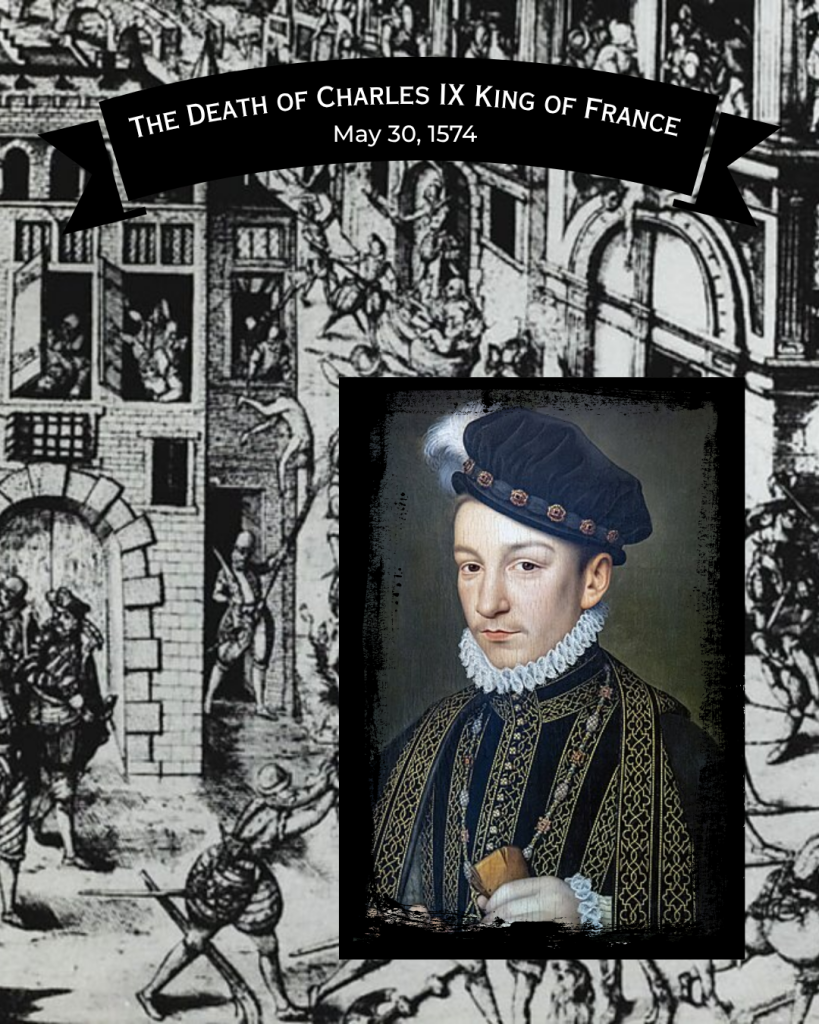
Charles the IX was the second son of Henry II and Catherine de Médicis. He became king upon the death of his brother Francis II, with his mother acting as his regent. Even after he was proclaimed of age on August 17, 1563, he remained under his mother’s domination (was there anyone Catherine couldn’t dominate?).
In 1571 Charles began to take his own path, after meeting and befriending the Protestant leader Gaspard de Coligny. Already jealous of the victories of his brother, the Duc d’Anjou (later King Henry III), over the Huguenots at Jarnac and Moncontour in 1569, Charles decided to favor a Huguenot plan for French intervention against the Spanish in the Netherlands. He sanctioned a defensive alliance with England and Huguenot aid to the Dutch.
Unfortunately for the King, his mother disliked his new policy and more than that was alarmed by Admiral Coligny’s ascendancy at Court and in her son’s inner circle. After an attempt on Coligny’s life (doubtless organized by Catherine) the Queen Mother persuaded Charles to order the massacre of St. Bartholomew’s Day. The resulting bloodshed was apocalyptic. Bodies littered the streets of Paris and were so thick in the Seine that witnesses testified one could walk across the river without wetting their feet.
The massacre haunted Charles the short life he had left. His health deteriorated, and he became increasingly melancholy. He died before his twenty-fourth birthday
Both Charles and The St. Bartholomew’s Day Massacre play central roles in Medicis Daughter. The massacre occurred shortly after Princess Marguerite’s marriage to Henri of Navarre, with guests who had traveled to witness the event slaughtered in Paris and some within the walls of the Palace itself.