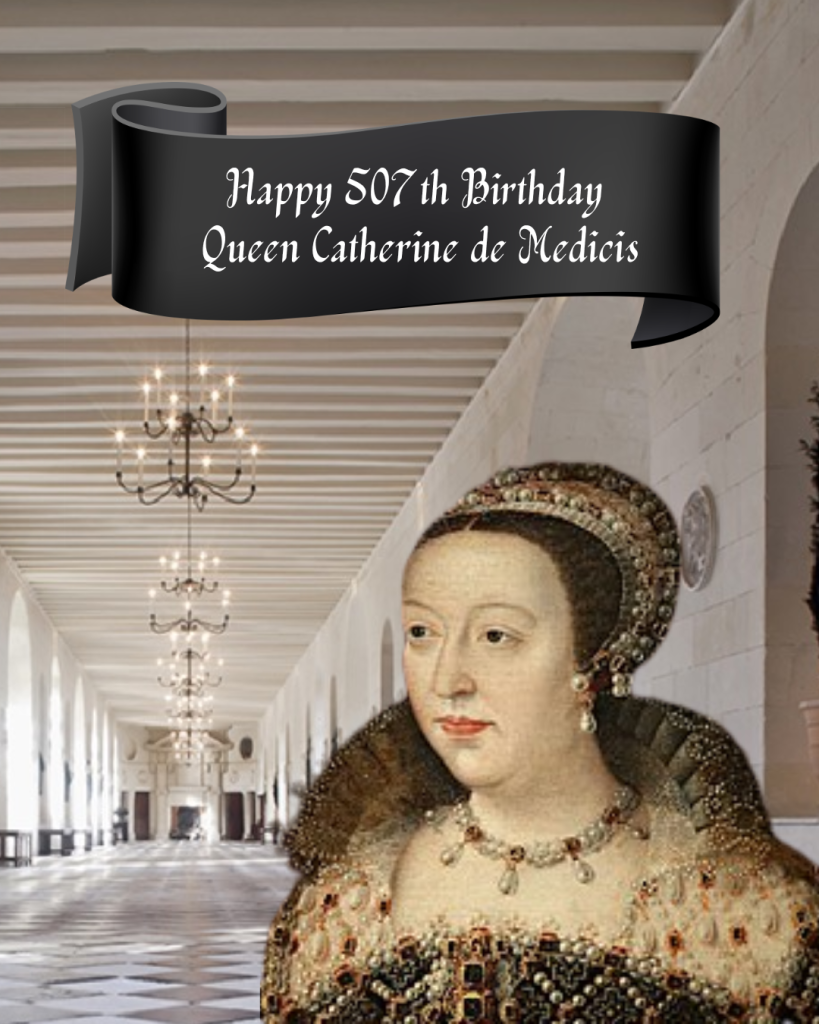
Happy 507th Birthday to Catherine de Médicis
Catherine de Médicis—a key character in my novel, Médicis Daughter and chief antagonist of it’s main character, Princess Marguerite—is remembered for her fierce political influence over each of her three sons who reigned in turn as King of France. But, as we celebrated her 507th birthday, it’s important to remember Catherine did not begin her life with power or, for that matter, with much to celebrate.
Although Catherine had illustrious parents—her mother was a French princess of royal blood and her father was Lorenzo de’ Medici—both were dead within a MONTH of her birth (and that was, incidentally, only about a year after their marriage). After they were gone, and because of her mother’s connection to the French crown, King Francis I claimed the right to raise the orphaned Catherine. But Pope Leo told the French King to pound salt. His Holiness didn’t real care about the infant Catherine—he just viewed her, Lorenzo’s legitimate heiress, as a useful pawn. Later in life, Catherine would remark that her eventual father-in-law, Francis I, was more of a father to her than His Holiness had ever been.
In the fall of 1533 when Catherine (they aged 14) was at last shipped off to France—to marry the future Henri II—her new husband was not even Dauphin. He was merely a second son. And he was already in love with his established Mistress Diane de Poitier. Diane was more sophisticated and far better looking than Henri’s new bride, and he showed very little interest in his wife. Catherine’s new country wasn’t impressed with her either. A report from one of the Venetian ambassadors declared that “all of France” disapproved of the marriage. So, Catherine’s experiences of being marginalized and rejected, begun in childhood, continued.
Yet from these inauspicious beginnings Catherine rose to be one of the 16th century’s true female power-players. A Queen who, left widowed with a large family, managed to keep her husband’s line securely on the throne during a time of nearly continual war. A woman who “managed” a series of boy kings—although arguably to their detriment and France’s.
Historians may disagree strongly on both the content and efficacy of Catherine’s policies with respect to the Wars of Religion—and just about everything else—but no one would disagree that she was a key influence in the post-Henri II Valois era. As such she deserves as much credit for what went right in that period as she does blame for what went wrong.