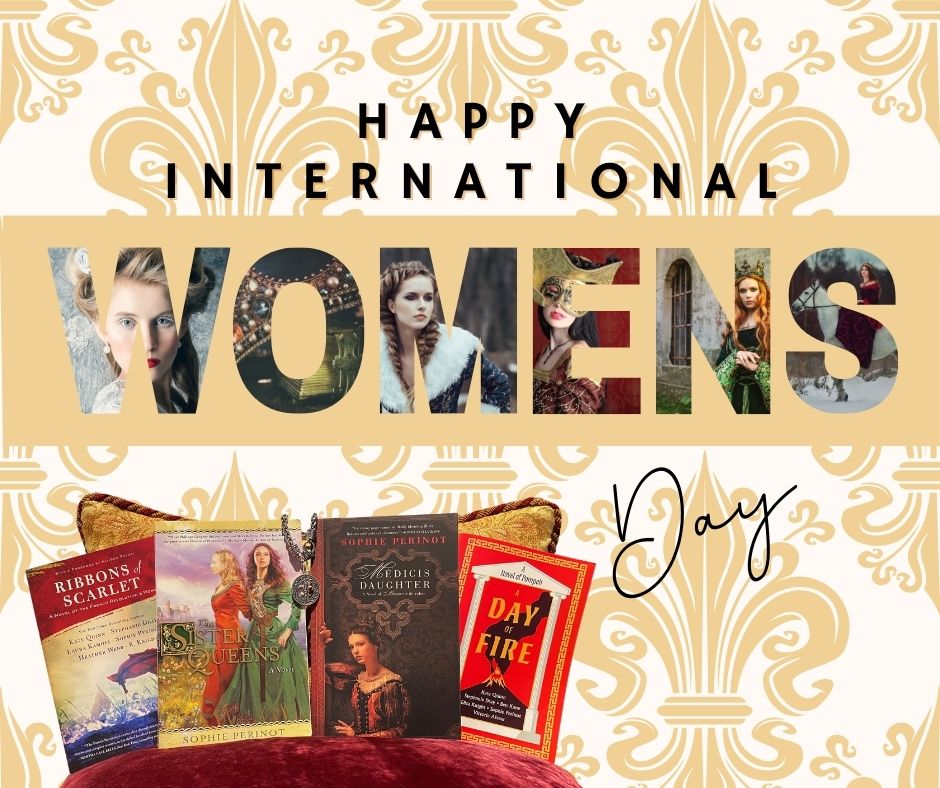
Happy International Women’s Day
I am SO HERE for International Women’s Day!
Doubtless my readers have noticed that I am an era hopper (I’ve written Ancient Rome, 13th century, 16th century, 17th century and who knows when I’ll go next) but my historical novels have a unifying factor—I like to restore or rehabilitate women who have been erased or mis-represented in history. So this International Women’s Day I’d like to celebrate some of my heroines.
The Erased . . . The spark for my novel, THE SISTER QUEENS, came from a footnote. I was reading about Notre Dame de Paris for a different project and came upon a footnote discussing Marguerite of Provence medieval Queen to Louis IX of France. She and Louis jointly presented the church’s last and smallest door—the Porte Rouge—and if you look up, you can see Marguerite’s kneeling image carved over that charming door. Anyway, in the footnote it was mentioned that Marguerite was one of four remarkable daughters of Raymond Berenger, Count of Provence—ALL of whom became Queens. I wondered how such women, with their powerful Savoyard connections through their mother and their politically significant marriages, could have slipped through the fingers of history. The fact they had aggravated me. So, I started a file folder with their names on it, vowing to come back and tell their story. The Sister Queens was the result of that vow and ultimately highlighted the two eldest, Marguerite who became Queen of France and Eleanor who became Queen of England. Neither of my Queens were mere pretty faces. Marguerite went on crusade and while their saved her husband, King Lois IX of France, who had been taken captive. Eleanor was her husband’s, King Henry III of England, rock—providing advice, perspective and unwaning love.
Another good example of restoring erased women is the collaborative novel that I worked on, RIBBONS OF SCARLET, about the French Revolution’s women. Women did everything from write to fight in support of the Revolution—the march on Versailles was led by women—but their significant contributions were largely left out of academic histories on the subject. I wrote about the King’s sister, Princess Elizabeth, lived a life of charity and was even considered for canonization by the Catholic church. At the time of the Revolution she took a stand to defend her brother, and was active in a plan to spirit her family to safety at the risk of her head, yet few people know anything about her. I wanted to correct that oversight.
The misrepresented . . . My novel, MEDICIS DAUGHTER, centers on Marguerite de Valois, youngest daughter of Catherine de Médicis, Queen of France. I knew Margot from my childhood reading, and specifically the work of Alexandre Dumas. Margot represents a woman unfairly treated by history. She’s traditionally been portrayed as a wanton. But these luridly embroidered portrayals are rooted in a single piece of propaganda. Propaganda used by her husband, King Henri IV of France, to secure a divorce when she didn’t produce an heir.
The defamation of Marguerite really fired me up to provide a more balanced, historically accurate look at the youngest Valois Princess.
Was she perfect? No. But nor was she a shallow, sex-obsessed, pleasure seeker. Looking at the historical record, it is clear Marguerite was highly intelligent, politically astute, and (in her later years) a serious force in the literary life of France. Arguably her political acumen exceeded that of her brothers (three of whom were Kings), making her more similar to her strong-willed, politically expert mother, Catherine de Médicis. Unlike her mother, however, Margot was a woman of deep and genuine religious conviction.
This International Women’s Day which historical women who’ve been erased or misrepresented have you enjoyed reading about? Is there a woman from the past you’d like to see someone write a historical novel about?